

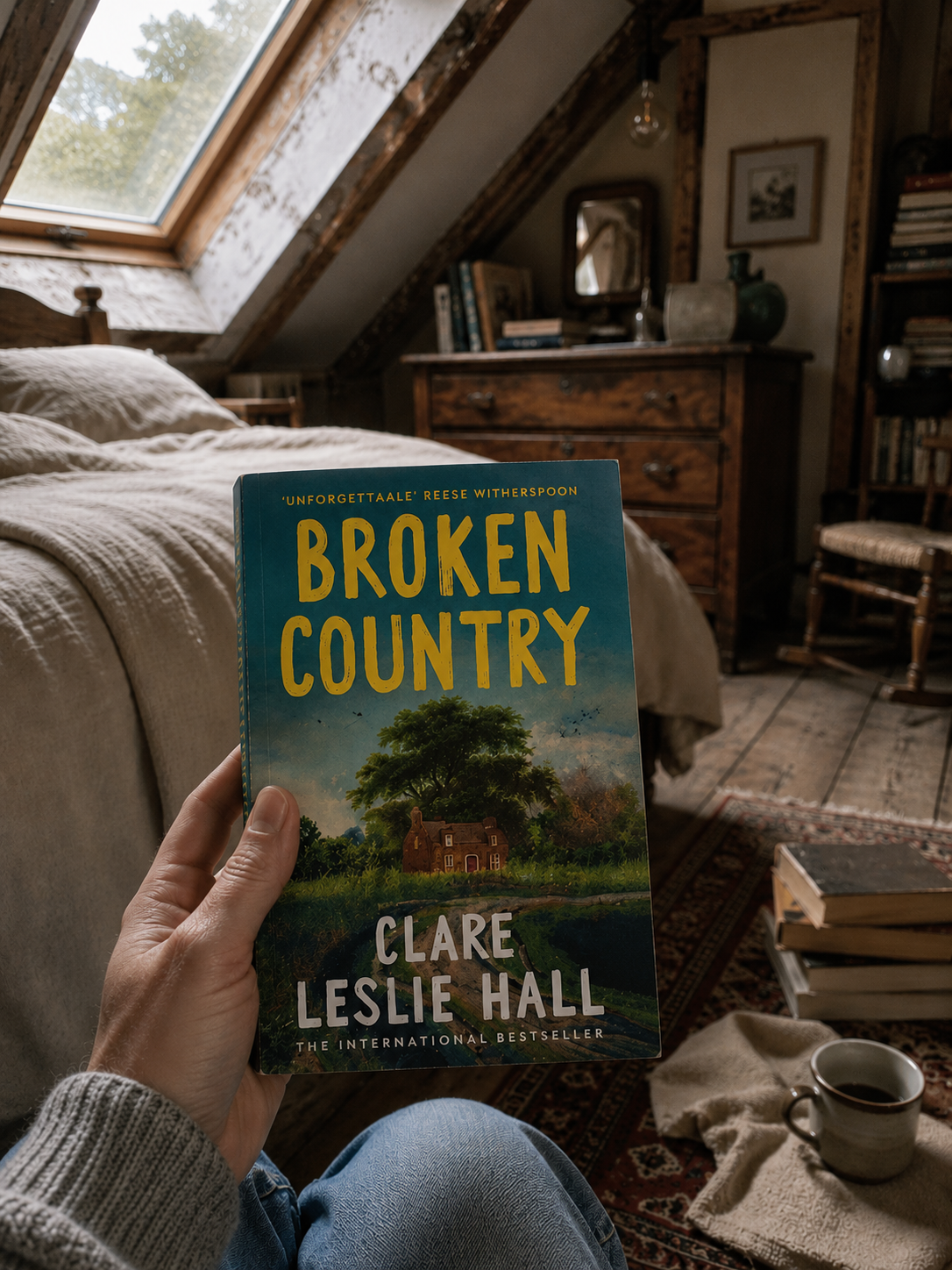
The room felt like it had settled into its own quiet rhythm. Morning light spilled through the skylight, catching the worn grain of the wooden floor and the stack of unread books waiting patiently in the corner. A half-finished cup of coffee had already gone lukewarm beside me, but I barely noticed. Broken Country seemed like the sort of novel that asked for an uninterrupted afternoon, one where there was nowhere else to be and no reason to keep checking the time.
It turned out to be exactly that kind of book.
At its core, Broken Country is a novel about the lives people build from difficult choices and the emotional cost that often lingers long after those choices have been made. Clare Leslie Hall takes familiar themes of love, family, memory, and belonging and approaches them with enough restraint that they never feel overly sentimental. Rather than relying on dramatic declarations, she allows relationships to reveal themselves through quiet conversations, shared histories, and moments that carry more weight than they first appear to.
One of the novel's greatest strengths is its emotional honesty. The characters are not designed to be easily admired or easily judged. They make mistakes, hold onto regrets, and struggle to reconcile who they once were with who they have become. That complexity gives the story its depth. I found myself changing my opinion of several characters as the narrative progressed, not because they behaved inconsistently, but because Hall gradually exposed new layers of their motivations.
The pacing is measured, almost contemplative. Readers looking for constant plot twists may find it slower than expected, but I appreciated that the novel trusted its characters enough to carry the story. The tension grows less from dramatic events than from the gradual realization that every decision leaves an imprint, even years later. There is a quiet inevitability to many scenes that made them surprisingly affecting.
Hall's prose deserves particular mention. Her writing is elegant without drawing unnecessary attention to itself. Descriptions of the countryside feel vivid but never excessive, serving as an extension of the emotional landscape rather than decorative passages. The rural setting becomes more than a backdrop. It reflects both the beauty and isolation that shape the characters' lives, creating an atmosphere that remains present long after individual scenes have passed.
I also appreciated how carefully the novel handles memory. Past and present are woven together naturally, allowing the story to reveal itself piece by piece rather than following a strictly chronological path. That structure encourages patience from the reader, and the emotional payoff becomes stronger because understanding arrives gradually instead of all at once.
Not every section carried the same intensity. There were moments where the deliberate pacing slowed enough that I wanted the narrative to move forward more decisively. A handful of secondary characters also felt less fully developed than the central cast, occasionally existing more to support the main emotional arc than to establish distinct identities of their own. These are relatively minor observations, but they stood out because the primary characters are written with such care.
What stayed with me most after finishing the novel was its refusal to offer simple answers. Broken Country understands that people rarely fit neatly into categories of right and wrong. Instead, it explores how love, loyalty, grief, and forgiveness often coexist in uncomfortable ways. That moral ambiguity gives the story a quiet maturity that feels increasingly rare.
As the afternoon light shifted across the room and the coffee beside me finally went cold, I realized I had spent far less time thinking about where the story was headed than about the people living inside it. That, more than anything, speaks to the novel's success.
Broken Country will likely resonate with readers who enjoy character-driven literary fiction where emotional depth matters more than plot mechanics. It is thoughtful without becoming heavy, moving without asking for easy sympathy, and reflective without losing sight of its narrative. Clare Leslie Hall has written a novel that lingers not because it seeks to overwhelm the reader, but because it captures something quietly recognizable about the ways people carry both love and loss through the lives they continue to build.