


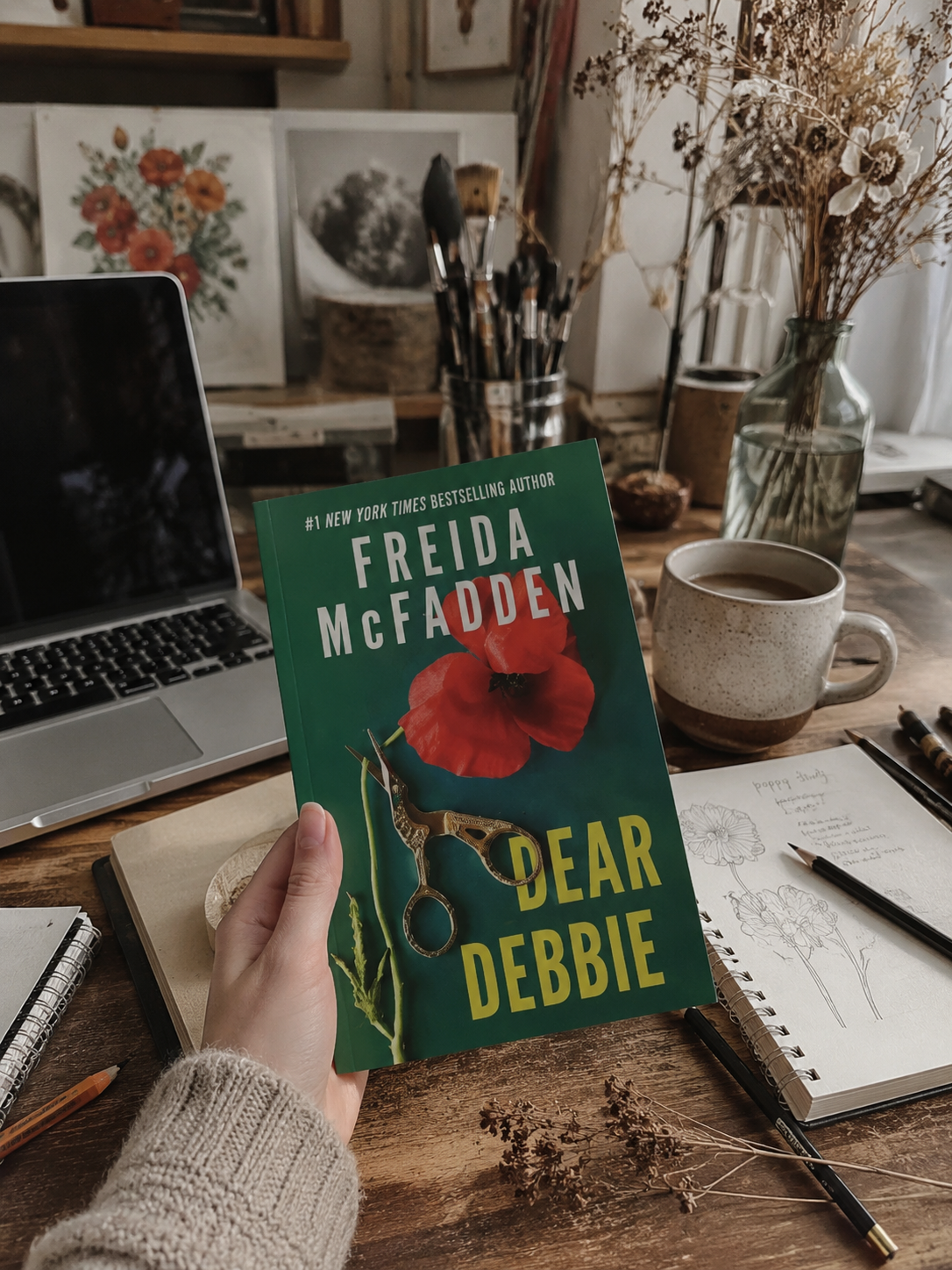
The desk was already cluttered before I opened the book. A notebook filled with half-finished sketches sat beside a cooling mug of coffee, dried flowers leaned against the window, and the laptop had long since gone dark from inactivity. It felt like one of those afternoons where there was no urgency to accomplish anything. The only decision left was whether to keep working or surrender to a story instead. Dear Debbie won that argument almost immediately.
Freida McFadden has built a reputation for writing psychological thrillers that thrive on ordinary settings hiding extraordinary secrets. I picked this one up expecting another fast-moving mystery built around unreliable perspectives, carefully timed revelations, and the kind of tension that quietly builds until you realize you've read half the book without looking away. For the most part, it delivers exactly that, while introducing enough emotional complexity to make it feel distinct from some of her earlier work.
The premise is deceptively simple. McFadden takes a familiar situation and gradually reveals that very little is as straightforward as it first appears. Rather than relying on elaborate twists from the outset, she spends time establishing relationships and allowing small inconsistencies to accumulate. Those moments become increasingly difficult to ignore, and before long, the story has shifted from curiosity to quiet suspicion.
What continues to impress me about McFadden's writing is her understanding of pacing. Her chapters are short without feeling abrupt, and nearly every one ends with just enough uncertainty to encourage another page. It is an approach that could easily feel manipulative in less capable hands, but here it feels earned because each revelation genuinely changes how earlier events are understood. She knows exactly when to answer a question and when to leave one lingering.
The characters are another strength. They rarely exist as simple heroes or villains, and that moral ambiguity keeps the novel engaging. Everyone seems to be protecting something, whether it is a secret, a memory, or a carefully maintained version of themselves. I found myself changing my opinion of certain characters several times throughout the book, which is usually a good sign in a psychological thriller. It suggests that the author trusts readers to revise their assumptions instead of confirming them too quickly.
McFadden also has a talent for writing dialogue that feels natural while quietly advancing the plot. Conversations often appear ordinary on the surface, but there is usually an uncomfortable undercurrent beneath them. A seemingly harmless exchange can take on an entirely different meaning a few chapters later. That attention to subtext is one of the reasons her novels remain so readable.
That said, there were moments where I wished the emotional side of the story had been explored with a little more patience. The novel maintains such a brisk pace that certain relationships occasionally feel defined more by the demands of the plot than by gradual development. The momentum rarely slows, which keeps the pages turning, but it also means a few quieter moments could have benefited from additional space to breathe.
The twists are handled well. They do not exist simply for shock value but emerge from information that has been present all along, even if it was easy to overlook the first time. Looking back after finishing the novel, I appreciated how many small details had been carefully positioned from the beginning. That sense of retrospect is one of the more satisfying aspects of McFadden's storytelling.
Beyond the suspense, Dear Debbie also touches on themes of trust, perception, and the stories people construct about themselves and those around them. It quietly suggests that certainty can be dangerous, particularly when it is built on incomplete information. Those ideas never overwhelm the narrative, but they give the thriller a little more depth than its brisk pace might initially suggest.
Closing the book, I realized I had barely touched my coffee and the afternoon had disappeared without my noticing. That is usually the clearest indication that a thriller has done its job well. Dear Debbie is unlikely to appeal to readers looking for dense literary prose or slow psychological introspection, but for those who enjoy character-driven suspense, shifting loyalties, and mysteries that reward close attention, it offers an absorbing reading experience.