


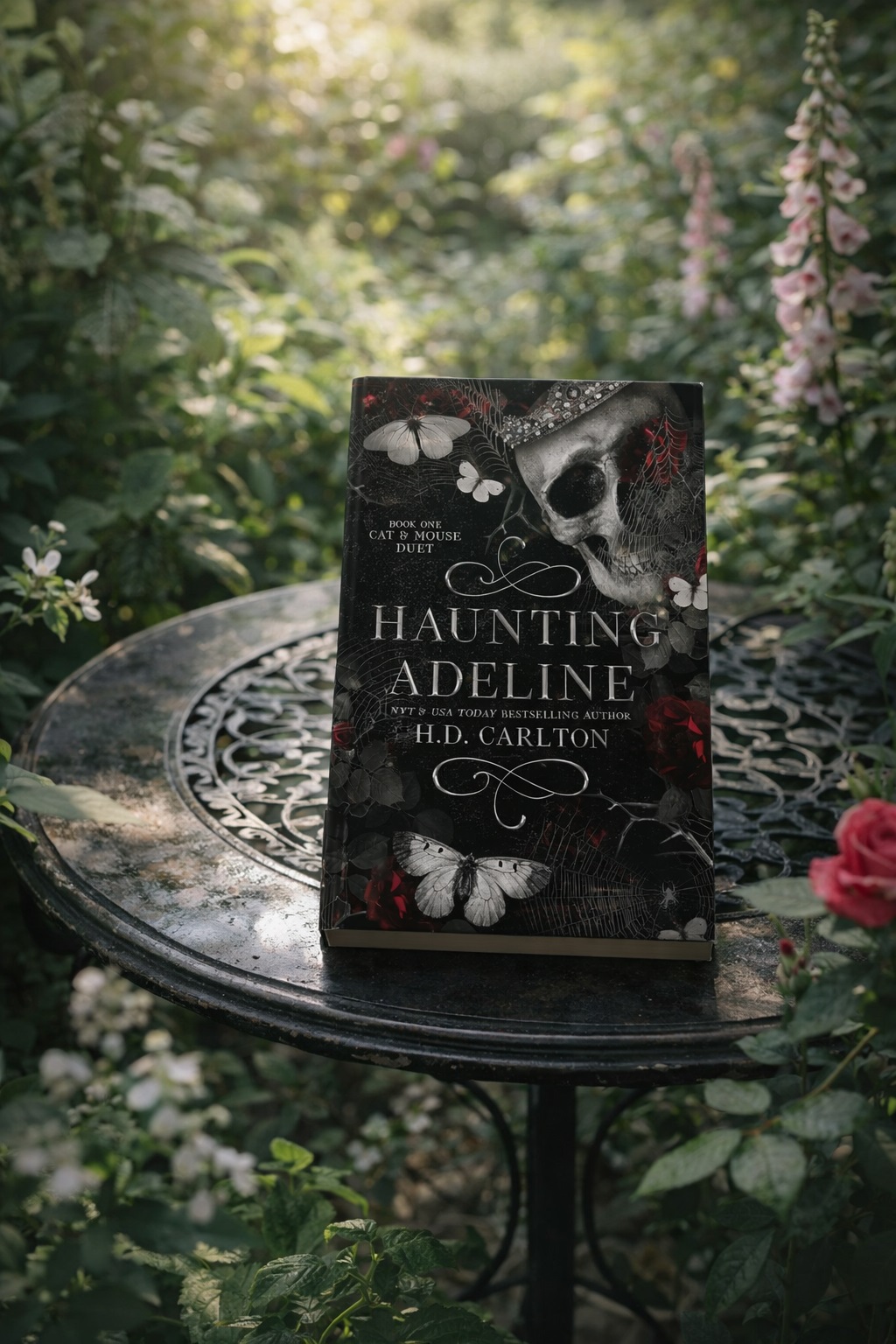
H. D. Carlton’s Haunting Adeline occupies a distinct place within contemporary dark romance. Positioned at the intersection of psychological suspense and explicit romantic obsession, the novel centers on Adeline Reilly, a writer who inherits her grandmother’s Gothic mansion and becomes entangled with a man who watches her long before he formally enters her life. The premise is deliberately provocative, and Carlton does not attempt to soften its edges. Instead, she leans into the discomfort, crafting a narrative that explores fixation, control, and the blurred boundary between fear and desire.
The novel’s structure alternates between perspectives, granting access to both Adeline’s interior world and that of her pursuer, Zade. This dual narration is central to the book’s impact. By allowing readers into Zade’s thoughts, Carlton removes the distance that might otherwise render him a purely external threat. His motivations are not framed as easily redeemable; rather, they are presented with unsettling clarity. The effect is disquieting. The reader is positioned to understand impulses that are ethically fraught, which creates a sustained tension between narrative immersion and moral discomfort.
Adeline herself is portrayed as intelligent and self-aware, though often emotionally reactive. Her inheritance of the mansion functions symbolically, situating her within a legacy of secrets and unresolved trauma. The house, with its hidden passages and lingering history, mirrors the novel’s interest in what is concealed beneath surfaces. Carlton makes deliberate use of Gothic elements, drawing on atmosphere and spatial confinement to heighten psychological intensity. The setting is not merely aesthetic; it reinforces the novel’s preoccupation with surveillance and intrusion.
Consent, power, and autonomy form the thematic core of Haunting Adeline. Carlton does not treat these themes lightly, but neither does she resolve them into clean moral lessons. The dynamic between Adeline and Zade is rooted in imbalance. The narrative repeatedly foregrounds the tension between resistance and attraction, control and surrender. For some readers, this exploration of coercive desire will feel transgressive in a way that invites examination of taboo fantasies. For others, it may feel deeply unsettling or ethically troubling. The novel’s willingness to remain in that tension is both its defining feature and its most contentious aspect.
Stylistically, Carlton favors direct, contemporary prose. The language is unembellished, often explicit, and paced for immediacy. Scenes are constructed to sustain intensity, whether through psychological confrontation or sexual encounter. The pacing is generally swift, though at times the narrative relies heavily on repetition to reinforce obsession. This repetition underscores the characters’ fixation but can occasionally narrow the emotional range of the story.
The thriller elements, including a subplot involving criminal investigation and vigilante justice, expand the novel’s scope beyond private obsession. Zade is positioned not only as a stalker but as a figure engaged in broader acts of violence justified through his own moral framework. This layering complicates the narrative but also introduces tonal shifts. The interplay between erotic tension and external danger sometimes strains coherence, as the novel attempts to balance intimate psychological drama with high-stakes action.
Character development in Haunting Adeline is uneven but purposeful. Zade is given significant narrative space, and his worldview is articulated with disturbing conviction. Adeline’s growth is more ambiguous. While she confronts fear and tests her own boundaries, her transformation is less about liberation than about adaptation. Carlton appears less interested in redemption arcs than in examining how desire can entangle itself with threat.
The novel’s emotional impact depends largely on the reader’s tolerance for dark romance conventions. Those familiar with the genre will recognize familiar motifs: the morally gray antihero, the obsessive protector, the conflation of danger and intimacy. Carlton intensifies these elements rather than moderating them. Readers who appreciate fiction that deliberately challenges comfort zones may find the book compelling in its refusal to dilute its premise. Readers seeking balanced romantic partnership or psychological realism grounded in mutuality may find it difficult to reconcile with the narrative’s dynamics.
Haunting Adeline is not subtle in its intentions. It aims to unsettle, provoke, and immerse. Its strengths lie in its atmospheric tension and its unapologetic exploration of taboo attraction. Its limitations stem from the same source, as the sustained emphasis on dominance and fixation can overshadow quieter emotional nuance. The novel invites discussion about the boundaries of fantasy, the ethics of representation, and the appeal of morally transgressive narratives.
Ultimately, Carlton offers a work that is unapologetically aligned with dark romance sensibilities. It is a novel driven more by intensity than by gradual psychological layering. For readers prepared for explicit content and morally complex dynamics, it provides a sustained, if polarizing, exploration of obsession and power.