

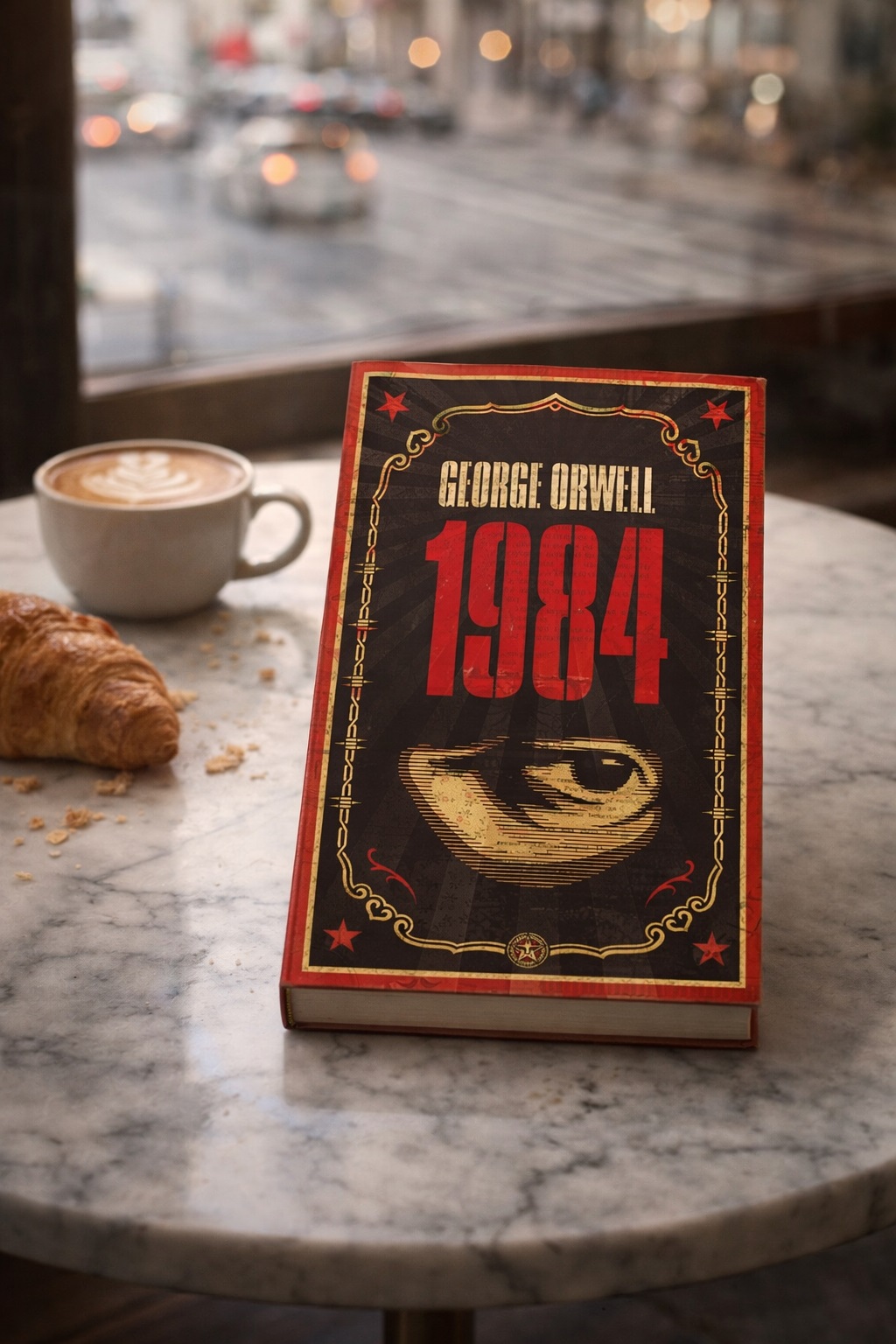
Nineteen Eighty-Four is one of the rare novels whose reputation is justified not because it predicts the future with uncanny precision, but because it understands the enduring mechanics of power.
First published in 1949, George Orwell's final completed novel is a work of dystopian and political fiction that imagines a society governed through surveillance, censorship, and the systematic erosion of objective truth. Its story follows Winston Smith, a minor Party official who begins to question the totalitarian state that shapes every aspect of his existence, and it has long been regarded as one of the defining novels of the twentieth century.
What I continue to admire most is Orwell's discipline. He was not simply trying to frighten his readers with a grim future, nor was he writing a disguised account of any single political regime. His larger purpose was to examine how authoritarian systems preserve themselves by controlling language, memory, and ultimately the individual's capacity to distinguish truth from falsehood. That ambition remains remarkably well served. The novel never loses sight of the human cost of abstract political ideas, and its emotional force comes as much from ordinary moments of fear and resignation as from its larger philosophical arguments.
Its greatest strength is the coherence of its vision. Every aspect of the imagined society reinforces Orwell's central concerns, giving the novel an unusual intellectual unity. Few works of fiction have introduced so many ideas that entered everyday language while remaining so firmly connected to the moral questions that produced them in the first place.
My only genuine reservation concerns its characters. They function effectively within Orwell's design, but they are not always afforded the psychological richness one finds in the greatest literary novels. At times, individuals seem to exist primarily as vehicles for the book's political argument. I do not regard this as a serious flaw, yet it does mean that I admire the novel's ideas slightly more than I cherish its people.
On my scale, five stars are reserved for books that achieve their artistic aims with exceptional authority and continue to reward careful rereading. Nineteen Eighty-Four earns that rating because its insights into power, language, and human frailty remain unsettling without depending on novelty or historical circumstance. It is both an accomplished novel and a lasting work of political imagination.
I would recommend Nineteen Eighty-Four most readily to readers who enjoy thoughtful literary fiction and who are willing to engage with difficult questions about freedom, truth, and the responsibilities of the individual within society.