


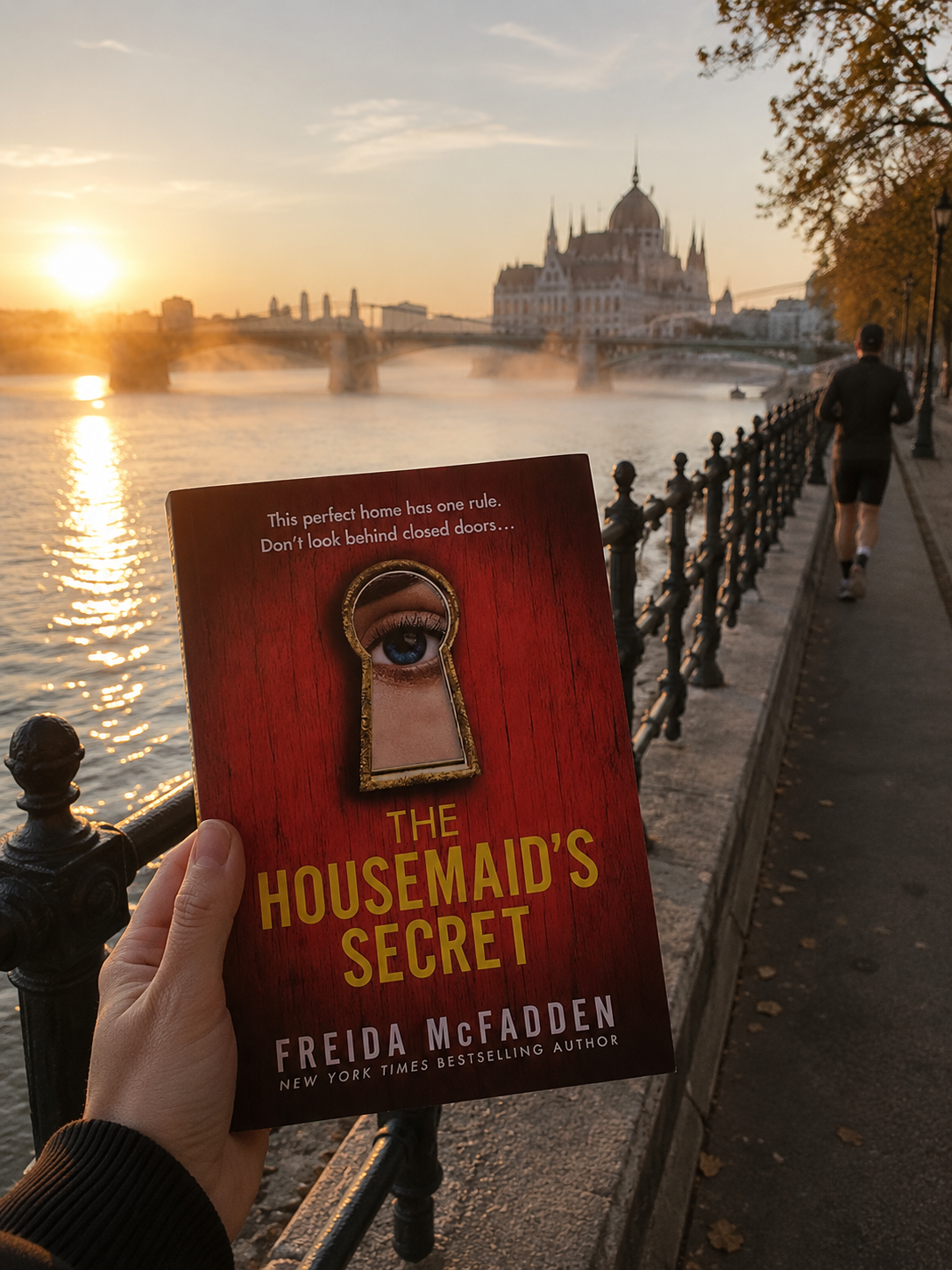
The Housemaid’s Secret is a domestic psychological thriller and the second novel in Freida McFadden’s Housemaid series. It brings Millie Calloway back into another wealthy household, this time as a cleaner for Douglas and Wendy Garrick. Douglas tells her that his wife is seriously ill and forbids her from entering the guest bedroom. Then Millie notices blood on Wendy’s nightclothes and hears her crying behind the locked door. Given Millie’s own history, she becomes convinced that a woman is being abused and that she cannot simply walk away.
That instinct is the most interesting part of the novel. Millie has built a personal moral identity around protecting women from abusive men, and she is studying toward social work. Her impulse to intervene is compassionate, but it is also complicated by her need to see herself as someone who helps. The book understands something important about rescuing others: good intentions do not necessarily produce good judgement.
The portrayal of domestic abuse is strongest when McFadden focuses on fear, isolation and control. Wendy's situation initially resembles the familiar pattern of an abusive marriage, while Millie's determination to help reflects the real difficulty of deciding when intervention is necessary. Readers who responded positively to this aspect have particularly noted the way the novel turns the idea of the rescuer back onto Millie herself. Other readers have found the characters too thinly drawn to make the psychological reversals fully convincing.
That criticism is fair. The central twist depends heavily on Millie behaving in ways that are sometimes difficult to reconcile with the experience and caution the novel has given her. Her emotional history is compelling, but her reasoning can become whatever the plot needs it to be. The supporting characters suffer even more. They function primarily as pieces in the machinery of the revelation rather than people with complicated inner lives.
There is also an interesting missed opportunity around mental health. The book deals with trauma, fear and the psychological effects of abuse, but it is more interested in suspense than in examining those experiences with much depth. That is not inherently a flaw in a thriller. It becomes one when the novel repeatedly gestures toward psychological complexity and then chooses the faster twist instead.
Still, McFadden understands the power imbalance built into domestic labour. Millie is simultaneously invisible and unusually observant, welcomed into an intimate household because she is paid to clean it while remaining socially disposable. That tension gives the story much of its atmosphere.
Content warnings include murder, domestic violence and anorexia.
The Housemaid’s Secret is ultimately more successful as a fast psychological thriller than as a nuanced examination of abuse. Its compassion is genuine, and its central idea has real potential. I only wish the characters had been given enough interior space to make that potential matter as much as the twists do.