


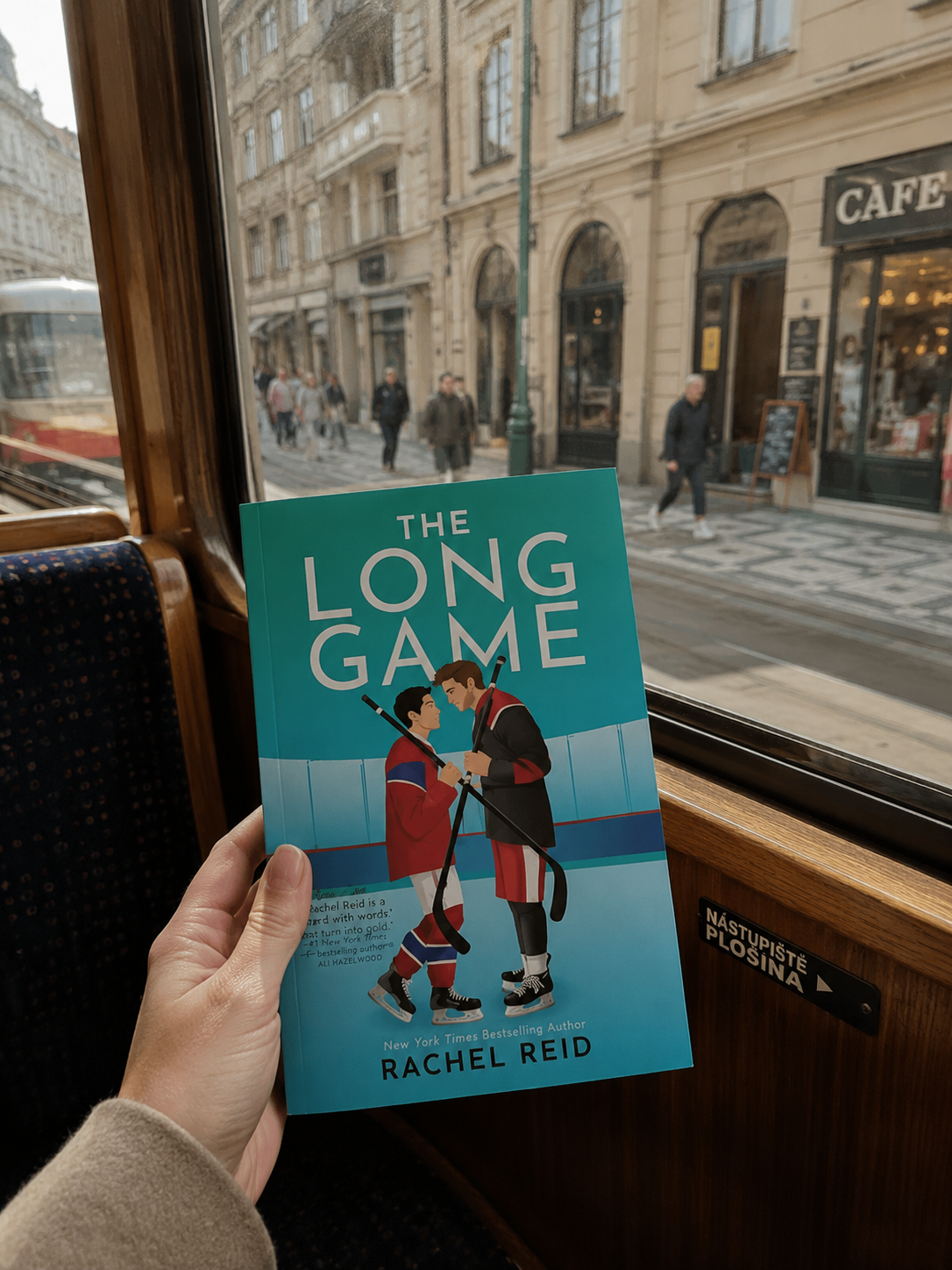
The tram moved through the city at an unhurried pace, its windows framing streets that felt alive without being rushed. Cafés were beginning to fill, pedestrians drifted between old buildings, and conversations disappeared as quickly as they appeared when the doors opened at each stop. I had brought The Long Game along expecting it to make the journey pass a little faster. Instead, somewhere between watching the city roll by and turning another page, I stopped paying attention to where I was altogether. The novel has that effect. It quietly draws you back into the lives of characters who already feel familiar, asking not whether love can begin, but whether it can endure once the excitement of falling in love has given way to the reality of building a life together.
After Heated Rivalry, returning to Shane Hollander and Ilya Rozanov felt less like meeting fictional characters and more like catching up with people whose story had never really left off. Rachel Reid makes a smart decision by resisting the urge to simply recreate what worked the first time. Rather than relying on the tension of forbidden attraction, The Long Game shifts its attention toward something arguably more difficult to write. It explores what happens after two people finally choose each other and discover that commitment brings its own set of challenges.
What immediately stood out to me was the emotional maturity of the novel. Many romances conclude at the point where characters confess their feelings, leaving readers to imagine everything that follows. Reid instead begins where many love stories end. Shane and Ilya are deeply committed to one another, yet they must navigate careers lived under intense public scrutiny, conflicting ambitions, and the emotional consequences of spending years protecting different versions of themselves. Their relationship is no longer built on possibility. It is built on daily decisions, compromise, patience, and trust.
Ilya once again became the emotional center of the story for me. His sharp humor and confidence remain intact, but Reid allows readers to see the exhaustion that exists beneath the surface. His struggle with mental health is handled with remarkable care, never becoming a plot device or defining his entire identity. Instead, it becomes one part of a much larger portrait of someone learning that vulnerability is not weakness. Those sections felt particularly honest because they avoided dramatic simplifications. Healing is shown as gradual, uneven, and dependent upon support rather than sudden transformation.
Shane's perspective is equally compelling. His instinct to remain composed often masks his own uncertainty, particularly when trying to support someone he loves while recognizing that not every problem has an immediate solution. Reid captures the quiet frustrations that can exist within healthy relationships, moments where love alone is not enough to remove fear or self-doubt. Those scenes give the novel an emotional credibility that extends well beyond romance.
The chemistry between Shane and Ilya remains one of the series' greatest strengths, but what impressed me most was how naturally it has evolved. Their banter still carries warmth and humor, yet it now feels shaped by years of shared history. Small gestures often communicate more than dramatic declarations. A conversation over dinner or a brief exchange after a difficult day frequently carries greater emotional weight than the novel's more overtly romantic moments. Reid understands that intimacy often reveals itself through familiarity rather than spectacle.
The hockey setting continues to provide structure without overwhelming the narrative. Professional sports remain an important source of external pressure, particularly regarding public image and career expectations, but the novel wisely keeps its attention on the emotional lives of its characters. Readers do not need extensive knowledge of hockey to appreciate the story because the sport functions primarily as the environment within which these relationships exist rather than the story's central focus.
If I had one criticism, it would be that certain sections move more deliberately than others. Because the novel prioritizes emotional processing over dramatic conflict, there are moments where the pacing becomes noticeably quieter. While I appreciated the reflective tone, a few scenes linger slightly longer than necessary before the story regains its momentum. Even so, those slower passages contribute to the overall authenticity of the relationship. Long-term partnerships are rarely defined by constant dramatic events, and Reid embraces that reality.
Beyond its romance, The Long Game explores identity, mental well-being, public expectation, and the quiet courage required to build an honest life in environments that often reward silence. It asks thoughtful questions about what success truly means if achieving it requires denying fundamental parts of yourself. Those themes emerge naturally through the characters rather than through overt commentary, giving the novel emotional depth without sacrificing readability.
As the tram slowed toward another stop, I looked up long enough to realize I had nearly missed where I intended to get off. The city outside was still moving at its own steady rhythm, but for several chapters I had been entirely somewhere else. The Long Game succeeds because it understands that sustaining love is every bit as compelling as discovering it. Readers who connected with Shane and Ilya in Heated Rivalry will likely find this continuation even more rewarding. It is a thoughtful, emotionally grounded novel that values honesty over drama and reminds us that the strongest relationships are often built not through grand gestures, but through the quiet decision to keep choosing one another every single day.