

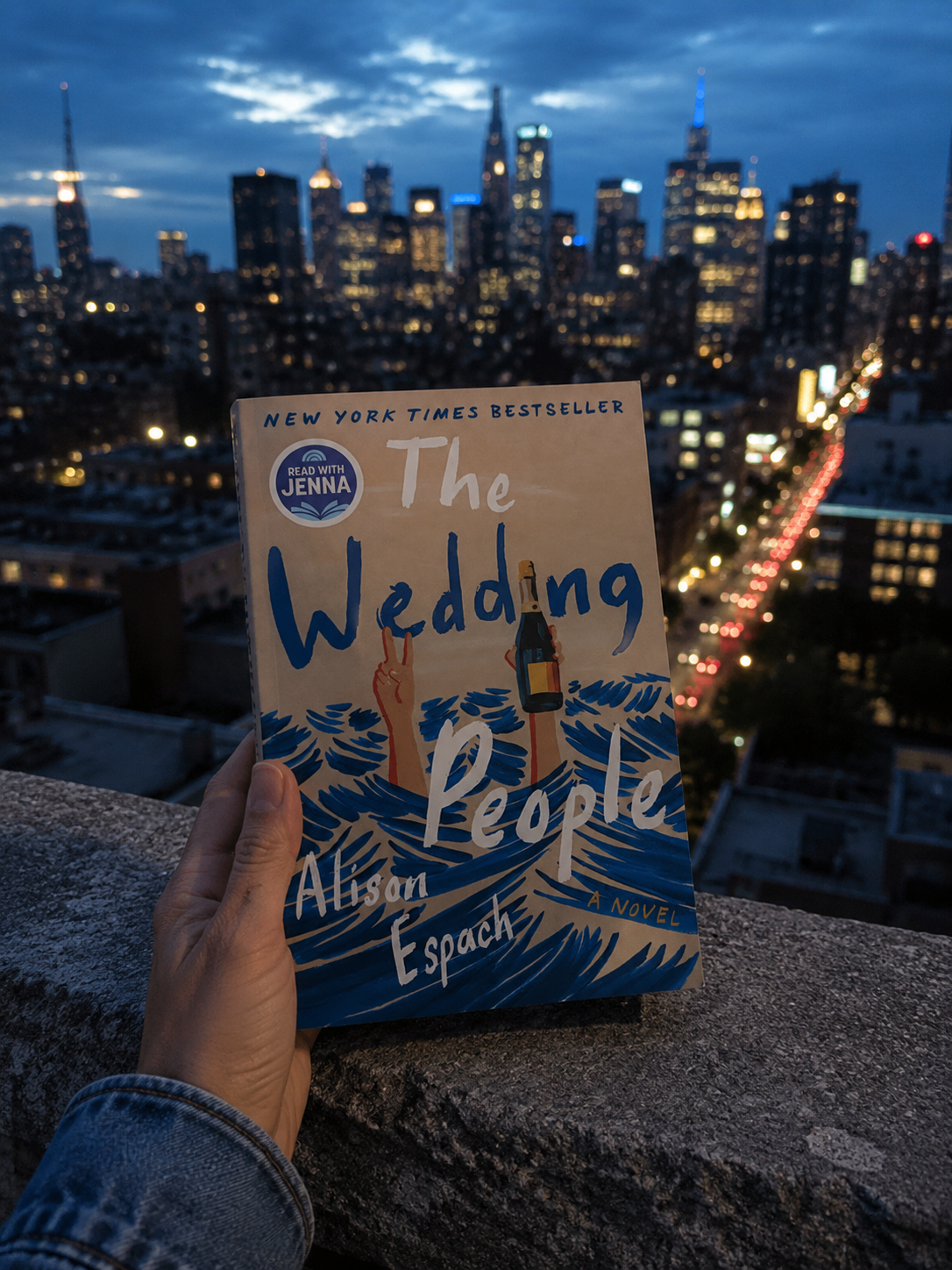
Cities have a way of making every story feel both insignificant and enormous at the same time. Standing above the streets after sunset, watching headlights stream endlessly between buildings while thousands of windows flickered to life, I found myself thinking about how many lives were unfolding at that exact moment. Somewhere below, people were celebrating, saying goodbye, falling in love, arguing over dinner, or quietly wondering what came next. Alison Espach's The Wedding People belongs to that last category. It begins with a life that has come apart, but it refuses to stay there.
The premise initially sounds as though it belongs to a dark comedy. Phoebe Stone arrives alone at an elegant seaside hotel where an extravagant wedding is about to take place. She has no connection to the bride or groom, and her reasons for being there are deeply personal. What follows is not the story I expected. Rather than centering on the wedding itself, the novel becomes an exploration of grief, chance encounters, and the surprising ways strangers can alter the direction of a life.
What makes this book work so well is its voice. Espach writes with an effortless balance of wit and vulnerability that never feels forced. There are moments where I laughed out loud, followed almost immediately by passages that carried genuine emotional weight. Few novels move so comfortably between humor and sadness without diminishing either. The comedy doesn't exist to distract from difficult emotions. Instead, it becomes one of the ways the characters survive them.
Phoebe is an exceptional protagonist because she feels unfinished. She isn't introduced as someone waiting to be fixed, nor is she presented as a symbol of resilience from the outset. She is exhausted, emotionally adrift, and trying to make sense of a future she no longer recognizes. Watching her gradually reconnect with the possibility of living differently became far more compelling than any single plot point. Her growth emerges through conversations, awkward moments, unexpected friendships, and quiet observations rather than dramatic transformations.
The wedding guests themselves gradually become more than colorful background characters. Each interaction reveals something about the complicated expectations people carry into marriage, adulthood, success, and happiness. Espach gently dismantles the illusion that anyone has completely figured life out. Behind polished celebrations and carefully planned events are people wrestling with disappointment, uncertainty, and private fears they rarely voice aloud.
One of the novel's quieter achievements is how it handles loneliness. It doesn't portray loneliness simply as being physically alone. Instead, it explores the strange isolation that can exist even when surrounded by other people. Several characters spend much of the novel performing versions of themselves they believe others expect to see. The emotional distance that creates often feels more significant than the physical setting itself.
Espach's prose is wonderfully observant. She notices the kinds of details that make scenes feel lived rather than constructed. A passing comment, an uncomfortable silence, or an offhand joke often reveals more about a relationship than pages of explanation could. I frequently found myself highlighting sentences not because they were especially lyrical, but because they captured familiar emotions with remarkable precision.
If there is one reason this novel has stayed with me, it is because it resists easy optimism. It believes people can change, but it never suggests that healing follows a predictable path. There are setbacks, uncomfortable truths, and moments where progress feels frustratingly small. That honesty gives the story its emotional credibility. Rather than offering neat resolutions, Espach allows growth to remain complicated and incomplete, much like life itself.
I also appreciated how the novel quietly questions the narratives we attach to milestones. Weddings, careers, relationships, and personal achievements are often treated as destinations that promise fulfillment. The Wedding People suggests something more nuanced. Those moments may shape our lives, but they rarely define them as completely as we imagine. Sometimes the most important turning point happens while someone else's celebration unfolds around us.
By the final chapters, I realized the novel had become much less about weddings than about second chances. Not the dramatic, cinematic kind, but the quieter opportunities that appear when people unexpectedly choose honesty over performance or curiosity over judgment. Those moments accumulate until they begin to reshape the emotional landscape of the story almost without the reader noticing.
Long after I finished reading, I found myself thinking about Phoebe rather than the plot itself. That, to me, is usually the mark of memorable fiction. The Wedding People succeeds not because it delivers surprising twists or grand declarations, but because it understands how profoundly ordinary encounters can influence a life already standing at a crossroads. It is warm without becoming sentimental, funny without undermining its emotional depth, and reflective without ever losing sight of the humanity at its center. It left me with the comforting reminder that even in the middle of someone else's story, we can still discover the beginning of our own.